Case File · Sumter County, FL
Case No. ZON26-000016
Re: Beville Ranch / "Beville Conservation Subdivision"
Public RecordFinal Vote · Jun 23

Stop the sprawl.

Protect Sumter's Agricultural Future

An application asks Sumter County to rezone 263 acres of working farmland at CR 476 & CR 476B, outside the urban area, into 84 house lots and a commercial pad. We didn’t write that. The county’s own file did. Read it.

Staff Report · ZON26-000016 · p.2Exhibit A

“The requested rezoning addresses a personal need and not a community need. …Staff finds the application in compliance with the minimum requirements … and recommends approval.

Deadline · the file closes in
20days
06hrs
35min
11sec

Independent resident campaign. Not affiliated with, endorsed by, or operated by Sumter County or any government agency.

Case summary · by the numbers
263
acres of farmland
84
house lots
0
central water / sewer
46
notices mailed
1
vote left · Jun 23
What’s actually being filed

A 263-acre rezoning, stamped “conservation.”

Case ZON26-000016 asks the county to rezone 257.62 acres of agricultural and rural-residential land at the SE corner of CR 476 & CR 476B. That land is outside the urban development area (uda). The plan turns it into a PUD: 84 house lots plus a 10.5-acre commercial tract.

It’s branded a “Conservation Subdivision,” under an ordinance the county adopted only in December 2024. The Special Master who heard it on June 1 only recommends. The real decision is the Board of County Commissioners on Tuesday, June 23, 2026.

Every claim about the rezoning here is drawn from the county’s own file or named press, linked at the bottom. The water and traffic gaps are exactly that: open questions the applicant hasn’t answered. Read the record yourself.

This is not anti-growth

Today the owner can already build large rural homesteads here by right: 5- and 10-acre lots. Nobody fought that, and nobody will. What we oppose is the 84-lot density, a commercial pad the code doesn’t allow out here, and the strain on wells, septic, and the aquifer that nothing in the file even measures. That’s sprawl dropped into farmland outside the urban area. Right plan, wrong place.
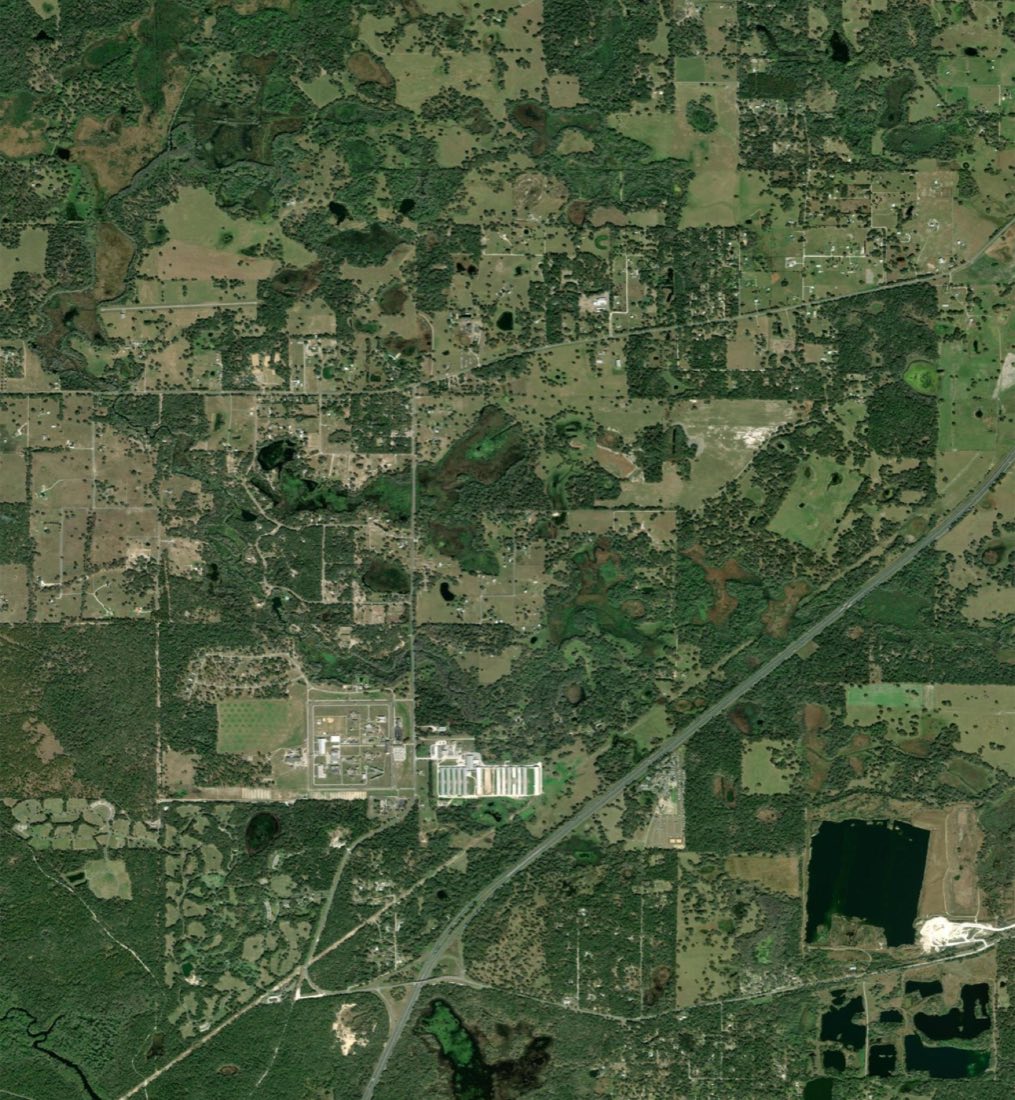
Aerial of the agricultural land and wetlands along the CR 476 / CR 476B corridor
Exhibit C, the site todayAerial: Esri
The load on this corner

17 homes within a half-mile. The plan adds 84.

Within a half-mile of this corner there are just 17 homes today, on the large rural lots, 5 to 10 acres, that this area is built on. The rezoning packs 84 more onto one parcel at 1 to 2 acre lots. Out here that is not simply more neighbors. With no central water or sewer committed in the file, it realistically means a private well and a septic tank for every one of those homes, on the same shallow aquifer the neighborhood drinks from, and 84 more rooftops shedding runoff toward the flood-prone Gum Slough.

17homes
Within a half-mile today
+84new homes
If the rezoning passes

Homes within a half-mile of this corner, from Sumter County GIS address points. No central water or sewer is committed in the county file, so the wells, septic systems, and runoff all land on the same ground as the existing neighborhood.

Up to 84
new private wells, drawing the same aquifer the neighbors drink from
Up to 84
new septic systems over that same shallow groundwater
84
more rooftops and driveways shedding runoff toward Gum Slough
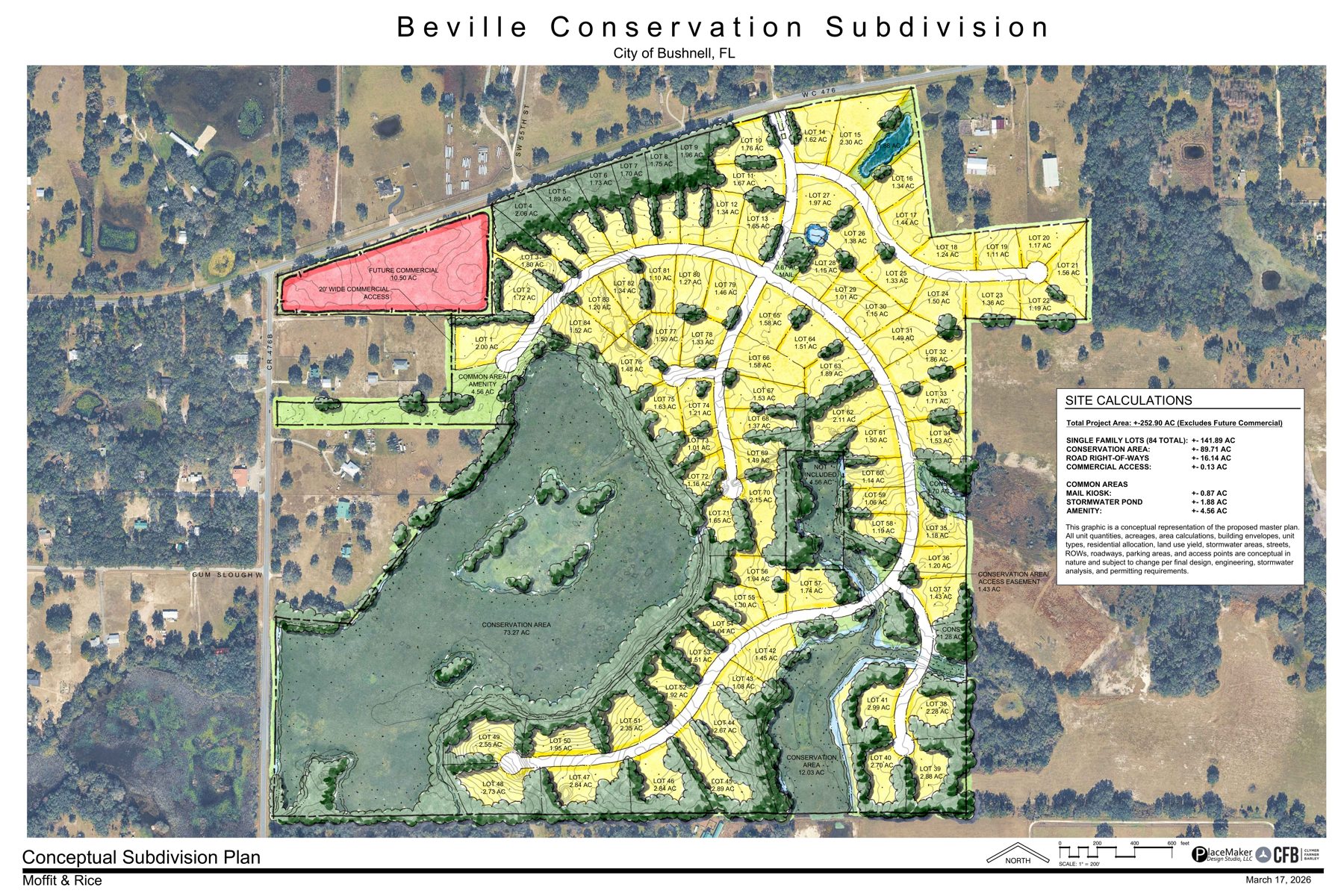
Applicant's conceptual subdivision plan for Beville Ranch: 84 lots packed onto one rural parcel
Their own plan: 84 lots packed onto one rural parcel.Applicant concept plan, Moffitt & Rice, in the county file

Homes within a half-mile from Sumter County GIS address points around the site (17, all but one residential; 207 within a mile). No central water or sewer is committed in the county file.

The case against it, from the county’s own file

The exhibits.

Staff's own wordsExhibit A

The county admits it serves a private profit, not a public need

Sumter County’s own planning staff report states, in black and white: “The requested rezoning addresses a personal need and not a community need.” Under the county’s own review criteria (LDC §13-323), community need is the test. Staff conceded there is none, then recommended approval anyway on “minimum requirements.”

“The requested rezoning addresses a personal need and not a community need.”
Sumter County Planning Division staff report, ZON26-000016
Outside the linesExhibit B

A "commercial" tract with no use, in a place the code says it can’t go

The plan parks a 10.5-acre “Neighborhood Commercial” tract on the corner. But the county’s own code (LDC §13-411(d)1) says Neighborhood Commercial may be allowed “provided the site is located within the UDA.” This site is OUTSIDE the UDA. Staff waved it through anyway because it “does meet the intent.” And the actual use? Undefined. The report says a traffic study comes later, “once a specific use is identified.”

“The site is located outside the Urban Development Area (UDA) but does meet the intent of the district…”
Staff report, on the Neighborhood Commercial tract
The "conservation" labelExhibit C

The plan they’re voting on doesn’t even meet the conservation rule

A “Conservation Subdivision” must permanently reserve at least 50% of the land (LDC §13-415(g)). The plan on the table shows only about 34%, and staff is trying to fix that later with a condition to “increase the conservation area up to the required 50%.” But conservation is not a detail to settle after the rezoning. It is the entire legal basis for it. The Board is being asked to approve a plan that does not yet meet the rule, on a promise to comply later. Before any vote, demand the compliant 50% reserve drawn on the plan, with the conservation-easement boundaries, the wetland and floodplain maps, and a funded management plan in the record. Meanwhile the 84 homes sit on lots of 1 to 3 acres, most between 1 and 2, far tighter than the 5 and 10 acre minimums in the current zoning.

“The conceptual plan lists about 34% of the subject property within a conservation area. The applicant shall be required to… increase the conservation area up to the required 50%.”
Staff report, on the conservation shortfall
The sprawl testExhibit D

263 acres of farmland, leapfrogged outside the urban area

The property is agricultural, designated Agriculture on the Future Land Use Map, surrounded on every side by agricultural land, and sits OUTSIDE the Urban Development Area, with no municipal water or sewer extension in the record. Eighty-four houses plus a commercial pad dropped into working farmland matches the kind of rural, outside-the-UDA development pattern Florida’s growth law (F.S. 163.3177(6)(a)9) tells local governments to scrutinize and discourage as urban sprawl.

Staff report; F.S. 163.3177(6)(a)9
The dodgeExhibit E

"We can only judge the minimums", the Board can judge more

Staff and the Special Master keep repeating that the application meets the “minimum requirements,” as if that ends the inquiry. It doesn’t. The June 23 hearing is quasi-judicial: the Board must weigh community need, compatibility with surrounding rural character, and the impact on neighbors (LDC §13-323). Meeting the minimum is the floor, not a free pass.

LDC §13-323 review criteria
Who got toldExhibit F

They mailed 46 notices for a 263-acre rezoning.

Notice goes to owners within about 500 feet of the property, not to households. We mapped that ring in the county’s own GIS: roughly 42 parcels and 35 owners, and about a dozen of those are empty lots with no home on them. So roughly 30 households got a heads-up about an 84-home subdivision and a commercial pad. County GIS counts more than 200 homes within a mile of this corner. The rest of the neighborhood heard some other way, or not at all.

Staff report: “Notices Sent: 46”; Sumter County GIS (500-ft notice ring)
The commercial question

What business is that 10.5-acre "commercial" tract even allowed to be?

Two rules box it in. First, a Neighborhood Commercial zone is allowed on Agricultural land only if the site sits inside the Urban Development Area, the county’s urban line (LDC §13-411(d)(1)a), and this corner is outside it. Second, on Agricultural land the Comprehensive Plan (Policy 1.6.8) allows only commercial that “directly supports surrounding agricultural uses.” So the ordinary strip-center retail people picture is not actually on the table here.

So the math only works one way. Limited to what is legal, this is a produce stand on a corner that already has a feed store, which is staff’s “personal need, not a community need” in one picture. The only reason to bank 10.5 commercial acres here is to bet the county will eventually allow the strip-center retail the code now forbids. That is exactly why the applicant left the use “undefined.”

Allowed in town, not here
  • Stores and general retail
  • A sit-down restaurant
  • Personal services
  • A small medical office
  • A beer & wine store

That is what a Neighborhood Commercial zone allows inside town. None of it is allowed on this corner, because on Agricultural land the rules only permit commercial that directly supports farming.

Allowed here
  • A roadside produce stand
  • Farm-supporting retail, and not much else

And a feed store already sits at the corner, so there is no unmet need. Outside the urban line, this commercial zoning does not belong here at all.

The wrong corner

Look at the corner they picked.

Of every place in Sumter County, the plan drops 84 house lots and a commercial pad here, on a rural corridor that is already spoken for.

A scenic byway

CR 476 is part of the Scenic Sumter Heritage Byway, a state-recognized scenic route through farms, ranches, hardwoods, and the Withlacoochee. The Beville corner sits at its western gateway. You do not start a strip-commercial corridor at the head of a scenic byway.

The road to a national cemetery

CR 476B, signed as Veterans Memorial Highway, runs about three miles south to Florida National Cemetery, where families bury and visit those who served. This is the approach to that ground. It deserves better than an undefined commercial pad.

No market out here

Along that same stretch of CR 476B sits Sumter Correctional Institution. The real neighbors of this corner are a state forest, a state prison, and a national cemetery. That is not a retail market, which is exactly why staff called this a personal need and not a community need.

This is the tell. You do not bank 10.5 commercial acres between a prison and a national cemetery, outside the urban line, at the head of a scenic byway, because the neighborhood needs a store. You bank it betting the line will move. That is speculation, not need.

Exhibit WThe question the file never answers

Power and fiber. No water. No sewer.

There is no municipal water or sewer at CR 476 & CR 476B, and none is committed anywhere in the record. Power and fiber run out there; the one thing that actually limits 84 homes plus commercial does not. With no central main in the file, every home realistically draws its own well and drains its own septic, onto the same aquifer the existing neighborhood already drinks from, beside Gum Slough and the Withlacoochee River. Unless the applicant shows otherwise, which the file does not.

84
homes · no water main

Outside the UDA with no central water in the record, so realistically a private well per home, all drawing the same aquifer neighbors already depend on.

84
homes · no sewer main

No central sewer in the record, so realistically a septic drainfield per home on 1 to 3 acre lots, beside Gum Slough and the Withlacoochee.

10.5 ac
commercial tract

Retail needs potable water AND wastewater service. The record identifies neither.

4.56 ac
amenity (pool/clubhouse)

A pool takes tens of thousands of gallons to fill and top off; a clubhouse needs restrooms and potable water.

A shared well serving the amenity or commercial isn’t a backyard tap, it can be a federally-regulated Public Water System.

EPA: a “public water system” serves 15+ connections or 25+ people. Its own textbook example of a regulated water system? “A gas station.” The very use neighbors fear is EPA’s example of something that needs a permitted public water system, with testing, treatment, and reporting. None of that is in the record.

U.S. EPA, “Information about Public Water Systems”

The file contains no water-supply or wastewater engineering at all. That isn’t a detail. It’s the whole feasibility question. Before any vote, the applicant should be made to put a water-supply plan, a well-interference analysis, and a septic/nutrient analysis on the record. This is the same “no path to municipal water and sewer” problem the Board used to deny Holcomb. The commissioner who also chairs the Withlacoochee River Water Supply Authority, Chairman Wiley, of all people should insist on that plan first.

For scale: a typical Florida household uses roughly 150–250 gallons a day. Eighty-four homes is on the order of 15,000–20,000+ gallons every day pulled from the same aquifer, before the pool, the clubhouse, and the commercial pad. (Illustrative, the applicant’s actual numbers are not in the record. That’s the point.)

It isn’t hypothetical. It already happened.

The Withlacoochee just flooded to levels this basin had not seen in generations.

In October 2024, Hurricane Milton drove major flooding on the Withlacoochee River. The USGS reported river levels in ranges not seen since the 1930s and 1960s. Sumter County issued evacuation notices along the river, water rescues were carried out, and county roads went underwater for weeks. Milton fell at the end of the wet season, on ground already saturated, with the aquifer full. That is the basin this plan wants to drain 84 rooftops and driveways of stormwater into, with the flood-prone Gum Slough counted as its “conservation.” Before any vote, demand a site-specific stormwater and floodplain analysis.

What the science says

The science says this ages badly. Our neighbors are already paying to undo it.

This is not a guess. Florida has studied what happens when you cluster wells and septic over the aquifer, and the cautionary tales are right next door.

10–50%
is all a conventional septic system removes before nitrogen reaches groundwater

UF-IFAS reports a conventional tank and drainfield removes only about 10 to 50% of nitrogen, so much of the rest reaches the aquifer. 84 systems clustered on 1 to 2 acre lots beside Gum Slough is a lot of nitrogen, year after year.

UF-IFAS onsite-sewage / nitrogen research (Ask IFAS SS550)
Drawn down
the same Upper Floridan aquifer everyone out here drinks from

The growing Villages and Wildwood area pulls hard on the aquifer Beville’s 84 wells would tap, which is why people out here are already drilling deeper. Before any vote, demand a SWFWMD or Withlacoochee River Water Supply Authority water-supply analysis for 84 more wells.

Demand: SWFWMD / WRWSA water-supply evidence
~90,000 homes
on septic that Marion County is now moving toward sewer

Right next door, septic nitrate helped impair Silver and Rainbow Springs. Marion County is studying and spending to convert septic to sewer. Beville would add 84 more septic systems and head the exact wrong direction.

Marion County Utilities wastewater feasibility study
~750 wells
went dry near Plant City when nearby pumping spiked

When concentrated groundwater withdrawals dropped the aquifer in the Dover/Plant City area, about 750 wells failed and the state created a water-use caution area covering more than 250 square miles. That was heavy farm pumping, far more than 84 homes. But it is the same physics: when many wells share one aquifer, the shallowest ones run dry first. That is exactly why a well-interference study belongs in this record before any vote.

Southwest Florida Water Management District

Staff put no water-supply plan, no well-interference analysis, and no nitrate study in the record. The Board should demand all three before any vote.

What’s at stake

This is what “conservation” is supposed to protect.

The same 263 acres the plan calls a “Conservation Subdivision” is working habitat. Neighbors see these animals on and around the property every week. Some of them are protected by law.

Gopher tortoise
Gopher tortoise
State-Threatened · keystone species

Its burrows shelter 350+ other animals. You cannot disturb a burrow in Florida without a permit.

Photo: Judy Gallagher · CC BY 2.0
Bald eagle
Bald eagle
Federally protected

A neighbor photographed one on the property’s fence line. Protected by the Bald & Golden Eagle Protection Act.

Photo: Andy Morffew from Itchen Abbas, Hampshire, UK · CC BY 2.0
Sandhill crane
Sandhill crane
State-Threatened (FL)

A regular sight in the wet prairies around this corner, the kind of habitat the plan puts at risk.

Photo: JeffreyGammon · CC BY 4.0
White-tailed deer
White-tailed deer
Resident

Plus foxes, bobcats, owls, and hawks neighbors see daily along CR 476.

Photo: USDA photo by Scott Bauer · Public domain

The reviewed June 1 packet includes no biological survey. Florida’s Comprehensive Plan and the county’s own conservation policies call for identifying protected species and habitat before development. Before any vote, demand a gopher-tortoise and listed-species survey on the record, and bring your photos.

They already did the right thing once

The Holcomb denial, May 26, 2026

Just 8 days ago.

The very same Board of County Commissioners rejected a far SMALLER rezoning west of Bushnell, a 20-acre parcel, 20 one-acre lots, because it was agricultural, outside the urban service area, on wells and septic, and “would never be connected to municipal water and sewer.”

Beville is the same fact pattern at roughly 13× the scale: 263 acres, 84 lots, plus a commercial pad, also outside the urban service area. This is about consistency. If those criteria denied 20 lots, the same Board applying the same criteria should ask why 84 lots and a strip-commercial corner clear the bar.

Villages-News.com, “Sumter commissioners make rare decision on property owner’s request,” May 27, 2026

“It’s an agricultural area. We’re not looking to develop that area.”

Commissioner Todd Coon (District 3)

“The change fails a test for urban sprawl.”

Commissioner Deb Butterfield (District 1), as reported by Villages-News
Anticipate the spin

Cross-examination.

Here’s what the applicant’s attorney will argue on June 23, and what the record actually says.

They’ll say

“It’s a Conservation Subdivision. It preserves 50% open space the county wouldn’t get otherwise.”

The record says

As submitted it preserves only about 34%. Staff had to make the 50% a future condition (LDC §13-415(g)). And 50% isn’t a gift, it is the code floor. Demand the compliant reserve, drawn on the plan with its easement boundaries and the wetland and floodplain maps, before any vote, not after.

They’ll say

“Neighborhood commercial belongs on this corner. It “meets the intent” of the district.”

The record says

The code text (LDC §13-411(d)(1)(a)) allows it only “provided the site is located within the UDA.” Staff admits the site is outside the UDA. “Meets the intent” is not what the code says, and the actual use is still undefined.

They’ll say

“A PUD is more restrictive than the current A10C/RR5C zoning.”

The record says

It unlocks 84 clustered house lots plus a commercial pad on land that is agricultural today. Intensity goes up, not down. That isn’t a restriction, it’s a rezone to suburban.

They’ll say

“Staff found it meets the minimum requirements.”

The record says

Minimum compliance is the floor, not a command to approve. The same report concedes the rezoning “addresses a personal need and not a community need” (LDC §13-323(b)). The Board can give that decisive weight.

They’ll say

“Property rights. We almost always uphold them.”

The record says

LDC §13-323(d) balances the owner’s rights against the impact on the public. This Board recently struck that balance against a far smaller rural rezoning (Holcomb). The same test applies here.

They’ll say

“It’s very low density: one home per 3.1 acres.”

The record says

That parcel-wide figure is diluted by the large wetland reserve along Gum Slough. Where people actually live, staff’s own number is one home per 1.9 acres. That is where 84 wells, 84 septic tanks, and the traffic concentrate.

They’ll say

“It’s an equestrian/ranch use. That fits a rural area.”

The record says

Then make them prove it. If the applicant claims an equestrian or ranch use, the Board should require the actual use, the facilities, the traffic, and the water and wastewater demand on the record, and show how it fits an Agriculture future land use. Right now the commercial use is undefined, and a label can’t carry an 84-lot subdivision.

They’ll say

“The area is supported by utilities from the City of Bushnell.”

The record says

It isn’t. City of Bushnell water and sewer do not reach this corner south of town, and the record commits no central service. This is unincorporated land outside the Urban Development Area. Before any vote, demand written proof of who actually provides water and sewer to 84 homes and a commercial pad.

They’ll say

“Buffers and screening will protect the neighbors.”

The record says

Read the conditions. The staff report itself says “landscape buffers and screening are not required” and “site lighting… shall not be required.” A buffer the developer can thin or clear isn’t protection. Demand enforceable, recorded buffer, tree, and lighting conditions before any vote, and remember that conditions are only as strong as the county’s willingness to enforce them.

The five who decide

Your commissioners. On the record.

You don’t cast a vote on ZON26-000016. These five do. There’s no public ballot. Your power is the comment entered into the record and the body in the room on June 23. They’re elected, and a full room with a stacked record is exactly what moved them on Holcomb 8 days ago ago.

District 1BOCC
Debora Butterfield

Villages-News reported that at the May 26 Holcomb hearing she said that kind of change failed a test for urban sprawl.

[email protected]
District 2BOCC
Andy Bilardello

Says (on his county bio) he represents everyone "whether you have a septic tank or public sewer." The rural neighbors opposing this are exactly those residents.

[email protected]
District 3BOCC
Todd Coon

Per Villages-News, at the May 26 Holcomb hearing: "It’s an agricultural area. We’re not looking to develop that area."

[email protected]
District 4BOCC
Jeff Bogue

EMS director, the person to ask what 84 homes does to rural response times on CR 476.

[email protected]
District 5, ChairmanBOCC
Don Wiley

Also chairs the Withlacoochee River Water Supply Authority, all the more reason to demand a water-supply plan before voting.

[email protected]

The comment tool below CCs all five automatically and files the original with Planning so it lands in the official record.

Write them now
Before any vote

What the record must show.

June 23 is a quasi-judicial hearing, not a rubber stamp. Under Florida law the Board must base its decision on competent substantial evidence and keep it consistent with the Comprehensive Plan (Fla. Stat. §163.3194). It can lawfully deny a rezoning that fails the county’s own criteria (LDC §13-323), and a final approval is reviewed in court, by certiorari, for due process and whether it rests on competent substantial evidence. But objections only count if they’re in the record. Here’s what the applicant should be made to answer, in writing, before any vote:

  1. 01Identify the actual, legally-permitted commercial use, or remove the 10.5-acre tract, which sits outside the UDA where the code requires Neighborhood Commercial to be inside it.
  2. 02Show the compliant 50% conservation reserve, with conservation-easement boundaries, a wetland/floodplain map, and a management plan, before approval, not “later.”
  3. 03Make the approved residential traffic study and its roadway level-of-service findings public, and require the commercial traffic study now, not one deferred until “a specific use is identified.”
  4. 04Show how 84 homes get water and sewage service outside the urban service area: wells/septic capacity, aquifer draw, and stormwater for a flood-prone corridor.
  5. 05Produce the school-capacity, emergency-response, and notice (affidavit + mailing list) records so the Board decides on competent substantial evidence, the quasi-judicial standard.
  6. 06Make a finding on COMMUNITY NEED under LDC §13-323, which staff’s own report says is absent.
Take action, it takes 3 minutes

Three ways to fight this. Do all three.

1

File your comment

Use the tool below. It writes a record-ready letter, CCs all five commissioners, and files it with Planning.

2

Show up June 23

A full room is pressure the Board cannot ignore, and your filed comment is already in the record. Be there, and speak if you can.

3

Spread the word

A yard sign on CR 476, a flyer to a neighbor, this link to your group chat. Reach the hundreds who never got a notice.

File your comment right now

Pick an angle, add your name, edit it in your own voice, and send. Thirty varied letters beat three hundred identical ones.

1 · Pick your angle

Identical form letters get discounted. Pick an angle, then edit in your own words, that makes yours count.

Your name and address establish that you’re a local stakeholder, it makes your comment carry more weight. They go only into your email to the county.

Short keeps it to the two strongest points so it opens in most email apps. Full is the complete record letter (if your app balks at the length, use “Copy letter”).

Goes to

To: [email protected] (enters it into the record)

CC: all five commissioners

Your name & address fill in automatically from the fields above when you send or copy.

Open in my email

“Open in my email” drops everything into your mail app, just review and hit send. No email app? Use Copy letter + Copy all email addresses and paste into webmail.

Be in the room

Tuesday, June 23, 2026

Quasi-judicial public hearing, the FINAL vote

Gloria Rowe Hayward Sumter County Service Center, 215 Gloria Rowe Hayward Way, Sumterville, FL 33585

6:00 PM, BOCC Regular Meeting

The vote is at the county’s brand-new Gloria Rowe Hayward Service Center, which opened in May 2026. Seating is limited, so come early. And if you cannot get a seat, your filed comment is already in the record, which is why filing counts as much as showing up.

Bring a jacket: the new service center runs cold, especially for older neighbors.

Add to calendar
Be counted

Tell us you’re in.

Numbers are leverage, and they help everyone plan: seating at the new service center is limited, so the sooner we know who is coming, the better we can tell people to arrive early. Say whether you’ll be in the room, grab a yard sign, or reach the organizers directly. No accounts, no logins, and your details never appear on this site.

Step into the room

Will you be there June 23?

Claim a yard sign

Want a sign for CR 476?

Reach the organizers

Question, tip, or want to help?

No accounts, no logins. The organizers read submissions privately, your info is never shown on this site.

Read it yourself, the transparency the county didn’t offer

The file.

Every claim about the rezoning is sourced to a public document. Don’t take our word for it. Open the file.

Beyond June 23

Save Sumter Alliance.

Save Sumter Alliance is neighbors standing together to keep rural Sumter rural where growth doesn’t fit.

Winning on June 23 stops one project. The Save Sumter Alliance exists to stop the next one, and to fix the rule that let this one get this far.

Count me in